
Beyond Genealogy: The Scientific and Institutional Distinction Between Ancestry, Peoplehood, and Sovereign Recognition. VSN
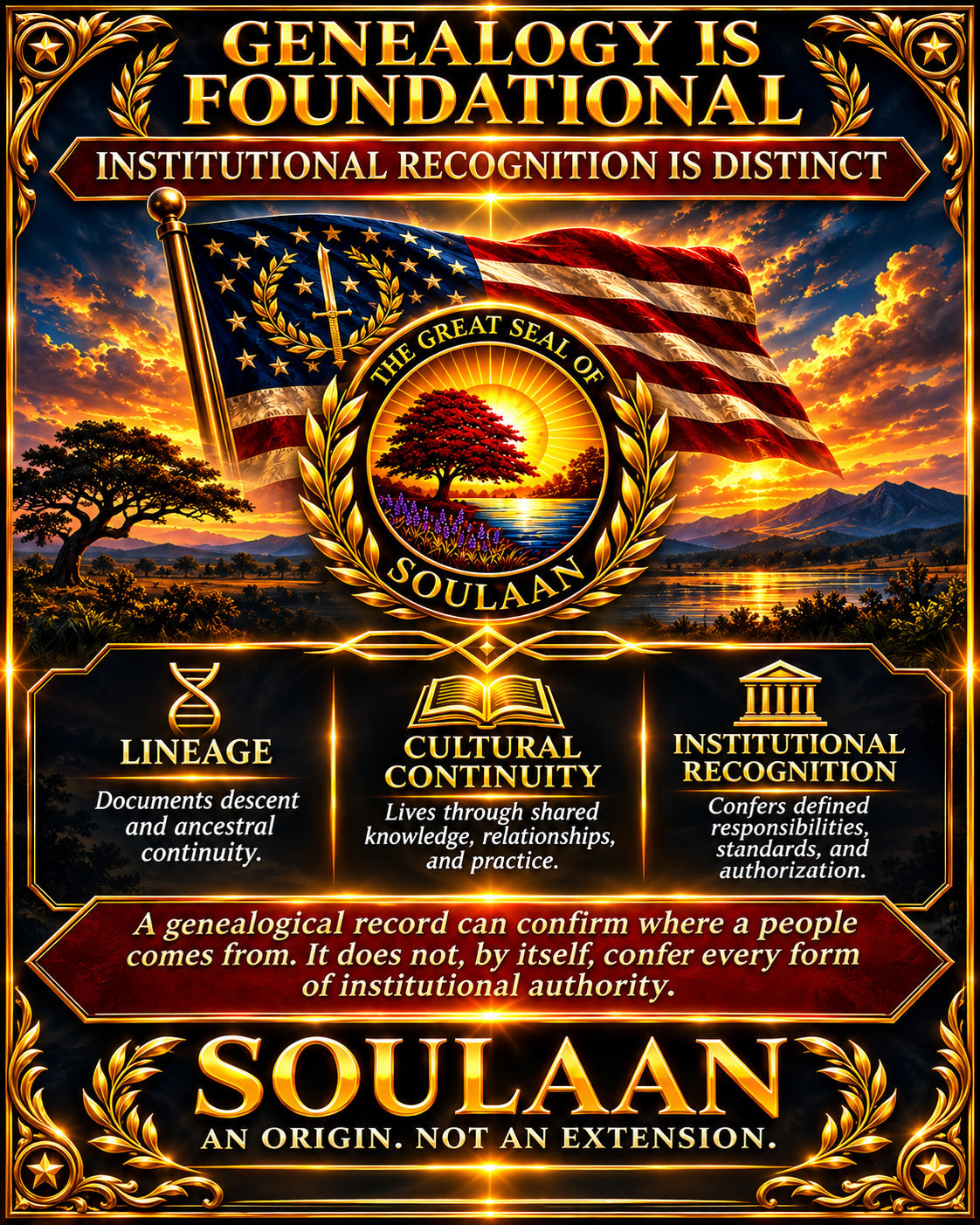
Why Genealogical Continuity Alone Does Not Establish Comprehensive Institutional Authority
The distinction between genealogical descent, cultural continuity, and institutional recognition is not merely a philosophical consideration. It is supported by established distinctions within contemporary scientific scholarship and illustrated by existing federal frameworks for collective recognition.
For Soulaan, an American-origin people whose collective identity is understood through historical continuity, territorial formation, cultural development, and community self-definition, these distinctions are particularly significant.
The central question is not whether genealogy matters. Genealogy is indispensable to establishing documented ancestral continuity. Rather, the question is whether genealogical evidence, standing alone, can establish every dimension of cultural belonging, institutional responsibility, and authorization to represent a people.
Scientific scholarship and comparative regulatory frameworks provide substantial reasons to distinguish these functions.
I. The Scientific Distinction Between Genealogical Ancestry, Genetic Ancestry, and Ethnicity
In 2023, the National Academies of Sciences, Engineering, and Medicine published Using Population Descriptors in Genetics and Genomics Research: A New Framework for an Evolving Field.
The report distinguishes between different forms of ancestry and population identification, emphasizing the importance of selecting descriptors appropriate to the particular question being examined.
Genealogical ancestry concerns documented familial relationships across generations. Genetic ancestry concerns inherited genetic material and its relationship to ancestral populations. Ethnicity encompasses additional dimensions of collective identity, including shared history, cultural practices, traditions, and social relationships.
Although these dimensions can overlap, they are not interchangeable.
A genealogical record can establish a documented relationship between an individual and historical ancestors. Genetic evidence can provide information about inherited biological ancestry. Neither form of evidence, independently, establishes the entirety of an individual’s cultural relationships, institutional responsibilities, or authorization to act on behalf of a community.
This distinction is also recognized by the National Human Genome Research Institute (NHGRI), which explains that ancestry, ethnicity, and other population descriptors serve different purposes and should not automatically substitute for one another.
The implications for Soulaan institutional recognition are substantial.
A person may possess documented genealogical continuity with the historical population from which Soulaan peoplehood emerged. That documentation may establish their descent under the applicable genealogical criteria.
However, ancestry documentation cannot independently determine whether that individual possesses the additional qualifications required to represent a Soulaan institution, administer protected cultural property, exercise delegated authority, or receive a particular institutional credential.
Genealogy establishes evidence of descent. Institutional authorization establishes the permissions and responsibilities granted by an institution.
These are related but distinct determinations.
Source: National Academies of Sciences, Engineering, and Medicine (2023), Using Population Descriptors in Genetics and Genomics Research: A New Framework for an Evolving Field.
Source: National Human Genome Research Institute, Use of Population Descriptors in Genomics.
II. Federal Recognition Frameworks: Descent Is Not the Only Criterion
An instructive comparison can be found in the United States Department of the Interior’s procedures for federal acknowledgment of American Indian tribes.
Under Title 25 of the Code of Federal Regulations, Part 83, federal acknowledgment is not ordinarily determined by historical descent alone.
The regulatory framework examines several distinct dimensions of collective existence.
Under 25 CFR § 83.11, these include evidence concerning:
1. Historical identification of the petitioning entity.
2. Existence of a distinct community.
3. Maintenance of political influence or authority.
4. Governing documentation.
5. Descent from a historical Indian tribe.
6. Membership requirements.
7. Congressional termination considerations.
These criteria demonstrate that the federal acknowledgment process recognizes distinctions between ancestral descent, sustained community relationships, and collective political organization.
In particular, 25 CFR § 83.11(b) addresses evidence of a distinct community, while § 83.11(c) addresses political influence or authority. Section 83.11(e) separately addresses descent.
This separation is significant.
The regulatory framework does not treat evidence of ancestry as necessarily equivalent to evidence of collective community continuity or political organization.
Instead, each requirement addresses a different aspect of the petitioning entity’s historical and institutional existence.
The comparison must be carefully understood.
These federal regulations apply to the acknowledgment of American Indian tribes. They do not establish Soulaan recognition standards, confer federally recognized tribal status upon Soulaan, or create a legal requirement that Soulaan adopt the same criteria.
Furthermore, federal acknowledgment under Part 83 concerns collective tribal entities rather than the issuance of individual cultural credentials.
Nevertheless, the regulations illustrate an established institutional principle: descent, community continuity, and governing authority may be evaluated as separate dimensions of recognition.
For Soulaan, this distinction provides a useful comparative framework for constructing an independent system of cultural and institutional recognition appropriate to its own historical circumstances.
Source: 25 CFR § 83.11, Criteria for Acknowledgment as a Federally Recognized Indian Tribe.
Source: 25 CFR § 83.43, Determination Decisions.
III. Applying the Distinction to Soulaan Acknowledgment Numbers and Verified Soulaan Numbers
Within the proposed Soulaan institutional framework, the difference between a Soulaan Acknowledgment Number (SAN) and a Verified Soulaan Number (VSN) becomes especially important.
The SAN, administered through the applicable Freedmen Nation genealogical verification process, serves as documentation that an individual has satisfied specified genealogical standards.
Its function concerns lineage verification.
The VSN, by contrast, is proposed as a broader institutional recognition credential administered under the authority of the Soulaan Polity and its designated representatives.
Its purpose is not merely to duplicate genealogical verification.
Rather, the VSN is intended to evaluate additional institutional qualifications, including cultural understanding, demonstrated integrity, accountability, reciprocity, respect for established boundaries, and compliance with legitimate governance requirements.
These standards concern authorization and institutional standing, not biological superiority or the intrinsic worth of an individual.
A genealogically qualified individual may therefore satisfy the ancestry component of the VSN process without automatically satisfying every additional requirement.
Importantly, withholding institutional authorization does not invalidate a person’s documented ancestry.
Similarly, recognizing someone’s genealogical descent does not automatically confer permission to represent Soulaan institutions, commercially license protected intellectual property, or exercise authority reserved to designated institutional representatives.
The distinction can be summarized as follows:
Genealogical verification establishes documented ancestral continuity.
Cultural continuity concerns the historical and social relationships through which a people maintains its collective identity.
Institutional recognition establishes whether an individual satisfies the particular responsibilities, qualifications, and authorization requirements of an institution.
The separation of these functions is consistent with the scientific distinction between ancestry and ethnicity and with the broader institutional principle illustrated by federal recognition procedures.
However, the scientific and regulatory sources do not themselves establish the validity of any particular Soulaan eligibility rule. Those rules require their own transparent justification, consistent application, and appropriate legal review.
IV. The Soulaan Three-Fold Law: Immunology as an Institutional Framework
The Soulaan Three-Fold Law provides a philosophical structure through which these dimensions can be organized.
Its three interconnected principles are:
SKY — SOLAR SELF — SOUL
The dimension of identity, purpose, collective self-definition, and directed responsibility.
LIVING DREAM FIELD — DREAMBODY — ECOLOGY
The dimension of cultural relationships, continuity, reciprocity, participation, and interaction within the living community.
EARTH — EARTHFORM — IMMUNOLOGY
The dimension of institutional boundaries, verification, accountability, protection, and the regulation of authorized activities.
Within biological science, immunology concerns the processes through which living organisms recognize molecular signals, regulate immune responses, maintain tolerance, and respond to biological challenges.
These functions provide a conceptual analogy for institutional discernment.
However, biological immune recognition cannot establish cultural or ethnic membership. Neither ancestry nor cultural difference makes a person a biological threat.
The institutional application of immunology must therefore be understood as an analogy concerning boundaries, regulation, proportional responses, and accountability.
Under this interpretation, the Earthform–Immunology principle does not authorize arbitrary exclusion.
Instead, it requires institutions to identify relevant evidence, distinguish legitimate qualifications from unsupported claims, maintain appropriate safeguards, and apply established standards consistently.
An institution that automatically grants every form of authority on the basis of genealogical documentation alone risks confusing ancestral eligibility with authorization.
Conversely, an institution that denies documented ancestry merely because an individual lacks institutional approval commits the opposite error.
A coherent recognition system must avoid both.
The Three-Fold Law therefore supports a conceptual separation between the recognition of ancestry, the examination of institutional qualifications, and the authorization of particular responsibilities.
V. Peoplehood Is Not Reducible to a Genealogical Registry
A people is not simply a collection of names appearing within a genealogical database.
Genealogical records can establish relationships between individuals and ancestors, but the historical development of a distinct people also involves cultural formation, shared institutions, collective experiences, territorial relationships, and the transmission of community practices.
For Soulaan, this distinction is central to the proposed framework of autochthonous American-origin peoplehood.
Soulaan identity is understood within this framework as emerging through a distinctive historical process on American soil.
The preservation of that historical continuity requires accurate genealogy, but preserving institutions and cultural practices involves responsibilities extending beyond the verification of individual family trees.
A genealogical registry can contribute to documenting the continuity of a population.
It does not automatically possess authority to define every aspect of that population’s cultural institutions, intellectual property, governance, or collective representation.
Such authority must derive from an identifiable and legitimate institutional or legal basis.
Consequently, the ability to verify descent should not automatically be interpreted as authority to issue every form of cultural or institutional recognition.
These are distinct responsibilities that may be assigned to different entities through clearly established agreements and governance procedures.
VI. Conclusion: Genealogical Continuity Is Foundational, but Institutional Authorization Is Distinct
Scientific scholarship demonstrates that genealogical ancestry, genetic ancestry, and ethnicity are distinguishable concepts.
Federal acknowledgment procedures for American Indian tribes further illustrate that descent, sustained community relationships, and political organization can operate as separate criteria within a recognition framework.
Neither body of evidence establishes a legal entitlement for Soulaan institutions or dictates their membership standards.
Together, however, they provide a reasoned foundation for distinguishing ancestry verification from broader institutional authorization.
Within the proposed Soulaan framework, genealogy remains essential to establishing documented lineage.
Yet the issuance of a Verified Soulaan Number, when defined as a comprehensive institutional credential, may legitimately involve additional standards concerning responsibilities, qualifications, and authorized representation.
These standards must be independently justified, transparent, consistently applied, and compatible with applicable law.
A genealogical record can document where an individual’s ancestry connects to a people. It cannot, by itself, establish every institutional responsibility or authorization that the individual is entitled to exercise on that people’s behalf.
The integrity of Soulaan recognition therefore depends not on diminishing genealogy, but on preserving the distinctions between lineage, cultural continuity, and institutional authority.
The purpose is not to make institutional recognition the source of ancestry.
It is to ensure that ancestry verification is not mistaken for unrestricted institutional authorization.
References
1. National Academies of Sciences, Engineering, and Medicine. (2023).
Using Population Descriptors in Genetics and Genomics Research: A New Framework for an Evolving Field.
National Academies Press.
https://doi.org/10.17226/26902
2. National Human Genome Research Institute.
Use of Population Descriptors in Genomics.
https://www.genome.gov/about-genomics/policy-issues/population-descriptors-in-genomics
3. United States Department of the Interior.
25 CFR § 83.11 — What are the criteria for acknowledgment as a federally recognized Indian tribe?
https://www.law.cornell.edu/cfr/text/25/83.11
4. United States Department of the Interior.
25 CFR § 83.43 — How will the Assistant Secretary make the determination decision?
https://www.law.cornell.edu/cfr/text/25/83.43
5. National Human Genome Research Institute.
Genetic Ancestry.
https://www.genome.gov/genetics-glossary/Genetic-Ancestry